
Why Have Ocean Freight Rates to the U.S. Increased Suddenly?
Within just one month, ocean freight rates to the United States have risen by 12–18%, putting continued pressure on Vietnamese exporters due to increasing logistics costs and shrinking profit margins. The simultaneous imposition of fuel surcharges and peak season surcharges by shipping lines has further intensified tensions in the maritime transport market.
Ocean Freight Rates to the U.S. Rise Sharply in a Short Time
Since late April, many international shipping lines have continuously announced surcharge increases on Asia–U.S. shipping routes.
According to MSC, the company has increased its emergency fuel surcharge on the Asia–U.S. East Coast route to USD 644 per 40-foot container and USD 467 per 40-foot container for the Asia–U.S. West Coast route.
Meanwhile, CMA CGM has implemented a peak season surcharge of USD 2,000 per container starting from May 1.
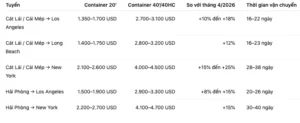
In Vietnam, container freight rates to the U.S. have also increased rapidly after a short period of stability:
- Ho Chi Minh City – Los Angeles: increased to USD 2,700 – 3,100 per 40-foot container
- Ho Chi Minh City – Long Beach: reached USD 2,800 – 3,200 per container
- Ho Chi Minh City – New York: rose to USD 4,000 – 4,500 per container
- Hai Phong – Los Angeles: fluctuated between USD 2,900 – 3,300 per container
- Hai Phong – New York: increased to USD 4,100 – 4,700 per container
The increase currently ranges from 10–20% depending on the shipping route.
Reasons Behind the Surge in Ocean Freight Rates
According to maritime transport market research organizations, the main reason behind the sharp increase in freight rates to the U.S. is that shipping lines have simultaneously added:
- Emergency fuel surcharges
- Peak season surcharges
- Price adjustments due to global supply chain disruptions
Notably, the price increases are occurring despite a slight decline in container imports into the U.S.
In April 2026, U.S. container imports reached approximately 2.28 million TEUs, down 3.2% compared to the previous month and 5.5% year-on-year.
However, shipping lines continue to maintain upward pricing momentum due to concerns over fuel costs, operational pressures, and risks of international logistics disruptions.
According to research firm Drewry, ocean freight rates to the U.S. may continue rising in Q3 2026 and could even reach USD 6,000 per 40-foot container on certain routes from Vietnam to the United States.
Vietnamese Exporters Under Heavy Pressure
The increase in ocean freight rates to the U.S. is creating significant pressure on many Vietnamese exporters.
Mr. Nguyen Ngoc Luan, CEO of Global Trade Connection Company (owner of the Meet More coffee brand), stated that businesses are struggling to cope with rapidly rising logistics costs while international demand remains weak.
According to the company, transportation costs have increased by approximately 20% since the beginning of the year, causing profits to fall short of covering production and logistics expenses.
In the cashew industry, the Vietnam Cashew Association (Vinacas) also warned that rising container freight rates to the U.S. are reducing export efficiency, even though the U.S. remains the largest consumption market.
Not only agricultural exporters, but textile, furniture, and fruit and vegetable businesses are also facing difficulties due to:
- Low profit margins
- Sharp increases in logistics costs
- Difficulty securing shipping space
- Shipping lines prioritizing high-value cargo
Many businesses reported that shipping lines are currently prioritizing electronics and components over bulky products such as furniture and agricultural goods.
Rising Logistics Costs Affect the Domestic Market
Not only exporters are affected, but rising ocean freight rates are also driving up import costs for raw materials.
According to the Ministry of Agriculture and Environment, imports of animal feed ingredients such as corn and soybeans increased significantly in both volume and value during the first four months of 2026.
Specifically:
- Corn imports increased by nearly 38%
- Soybean imports increased by more than 58%
- Soybean import prices rose by over 5%
Higher transportation costs are considered one of the factors keeping raw material prices and animal feed prices at elevated levels.
This continues to put pressure on production costs and consumer prices in the domestic market.
Businesses Need to Be Proactive Amid Freight Rate Volatility
As ocean freight rates to the U.S. continue to fluctuate strongly, industry associations recommend that businesses proactively review their logistics plans and transportation contracts.
Exporters are advised to:
- Closely monitor container freight rate movements
- Work early with shipping lines and freight forwarders
- Proactively negotiate surcharge terms
- Build flexible delivery plans
According to logistics experts, amid ongoing volatility in the global shipping market, proactively controlling costs and optimizing supply chains will be critical for businesses to maintain their competitiveness.